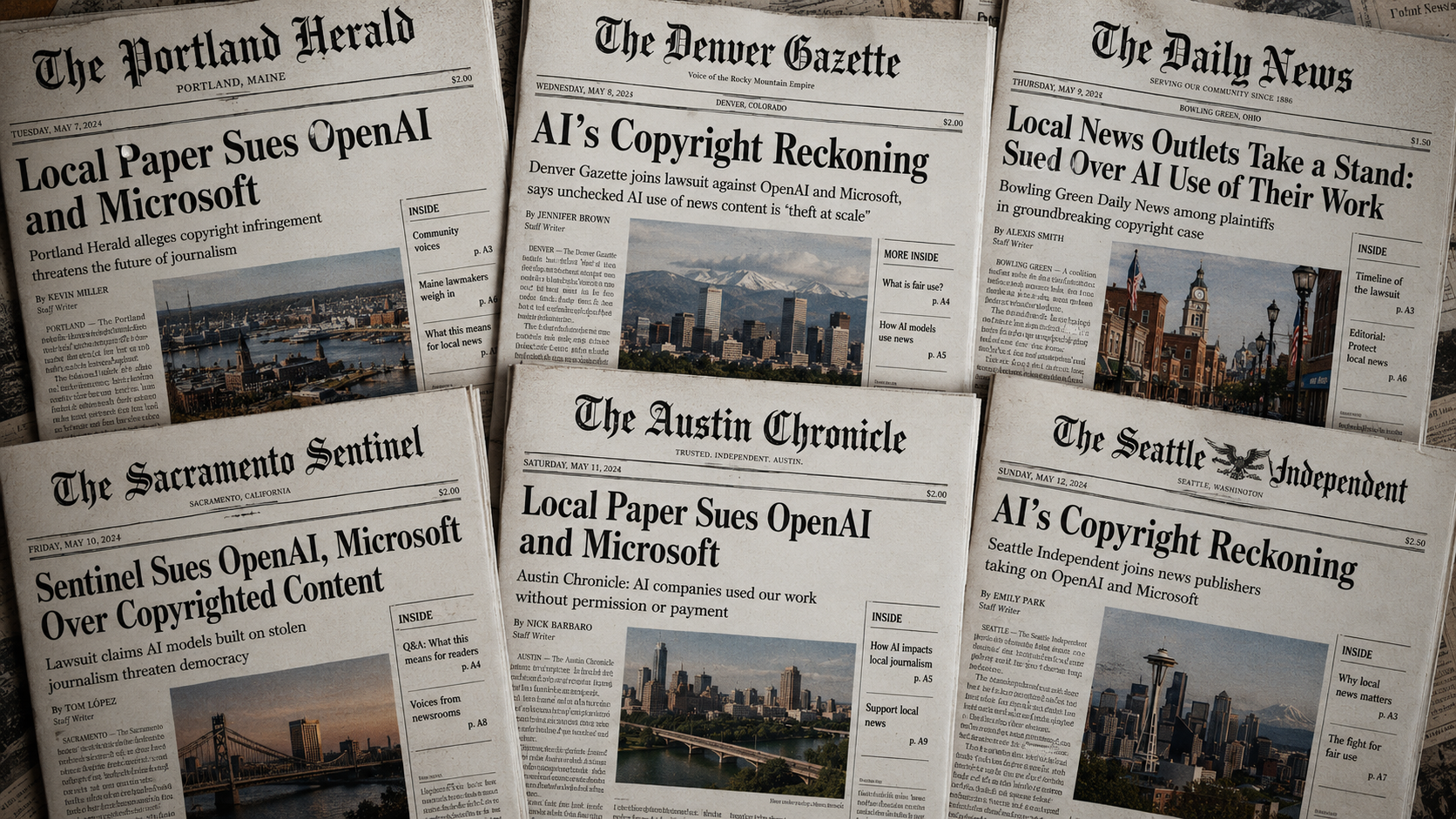
Nearly 400 local newspapers are taking OpenAI and Microsoft to court.
June 24, 2026
A massive coalition representing nearly 400 local and regional newspapers filed a joint lawsuit against OpenAI and Microsoft. The publishers are alleging the systematic, willful theft of their copyrighted journalism to train massive AI models like ChatGPT.
We’ve seen media companies take the tech giants to court before, but this case represents the largest collective effort by local news publishers to challenge AI companies over the unauthorized ingestion of their data. These are family-owned newspapers, regional chains, and community papers drawing a hard line in the sand.
Why Local Data Matters
Most people think of AI training data as an endless ocean of generic web text. But to make AI systems truly useful—to stop them from hallucinating and ground them in reality—they require high-quality, human-verified information.
For decades, local newspapers have funded the difficult, expensive, and decidedly unglamorous work of covering city council meetings, documenting regional crime, and investigating local corruption. Someone had to pay a reporter to be in the room, and someone had to pay an editor to vet the facts.
Now, the publishers are arguing that their costly civic infrastructure was scraped, absorbed, and monetized without permission or compensation. If a user can simply ask an AI chatbot to summarize a local zoning dispute or explain a municipal election without ever clicking a link to the local paper, the economic foundation that keeps those newsrooms alive is undercut. The AI isn’t just learning from their work; it’s actively replacing the need to read it.
The Copyright Collision
As regulatory and legal pressure tightens around AI data scraping, this lawsuit pushes the tech industry toward a critical inflection point. For AI companies like OpenAI and Microsoft, the argument has largely been that training models on publicly accessible internet data falls under fair use. They argue that their models learn the way humans do.
But for the publishers, it’s a matter of basic survival. If this ongoing copyright litigation is successful, it could fundamentally force changes to the economic frameworks and data accessibility required to train future frontier models. The era of consequence-free web scraping may be coming to a rapid close. Moving forward, AI labs will likely have to strike massive, industry-wide licensing deals or figure out entirely new, legally compliant ways to source high-quality training data.
The Bigger Picture
This lawsuit isn’t just about copyright. It’s about what happens when a new technology becomes a fundamentally better way to access information than the systems that came before it.
For most people, asking an AI assistant to explain a local zoning dispute, summarize city council decisions, or compare years of reporting is simply a better experience than searching through dozens of individual newspaper websites. It’s faster, more comprehensive, more accurate, and can be done through conversation. As AI continues improving, that shift in user behavior is unlikely to reverse.
History is full of technologies that displaced older industries because they offered a better way of doing the same thing. Digital photography replaced film. Streaming replaced DVDs. GPS replaced paper maps. AI may now be doing the same for information retrieval itself.
That doesn’t mean original journalism has become less valuable. If anything, it’s become more valuable, because frontier AI depends on large quantities of reliable, human-produced information. The challenge isn’t preserving the old distribution model. It’s building a new economic model that continues to reward the creation of high-quality knowledge while allowing society to benefit from dramatically better ways of accessing it.
The future of intelligence depends on both innovation and information. The winners won’t be the organizations that prevent technological progress, but those that discover sustainable ways to create, license, and distribute knowledge in an AI-native world.
Leave a Reply