How foundation models, humanoid robots, and simulation are turning artificial intelligence into a new layer of industrial infrastructure.
July 12, 2026
After years of rapid progress in text, images, and code, artificial intelligence is increasingly being deployed through machines capable of perceiving, reasoning, and adapting in real-world environments.
This emerging field, often described as “Physical AI,” is expected to drive a major expansion of the robotics industry. The market for AI-powered robotics is projected to reach approximately $150 billion by the mid-2030s as intelligent machines move from experimental demonstrations into factories, warehouses, farms, construction sites, hospitals, businesses, and homes.
The Shift from Bespoke to General-Purpose Intelligence
Traditional industrial robots are highly effective within controlled environments, but they are also highly specialized. Engineers must program their movements around a predefined task, a predictable workspace, and a narrow range of possible conditions. A change in the product, environment, or process may require the system to be redesigned or reprogrammed.
Vision-Language-Action (VLA) models are beginning to change that approach. These systems combine visual perception, natural-language understanding, and motor control within a unified model, allowing robots to interpret instructions and determine how to carry them out in the physical world.
Rather than receiving a detailed sequence of programmed movements, a robot could be given an instruction such as “clear this debris” or “place these objects in the correct containers.” It would then identify the relevant objects, assess its surroundings, plan a sequence of actions, and adjust its movements as conditions change.
Foundation models such as NVIDIA’s Isaac GR00T, alongside emerging world models and robotic control systems, are helping shift robotics from fixed automation toward more adaptable, general-purpose intelligence. The goal is not necessarily to create one machine capable of performing every task, but to build systems that can learn new operations without being reconstructed from the ground up each time.
Scaling Through Virtual Training
Training robots in the physical world is slow, expensive, and potentially dangerous. Every movement takes real time, equipment can be damaged, and rare situations are difficult to reproduce consistently. This has created a major data bottleneck for robotics, especially when compared with digital AI systems that can be trained on enormous datasets.
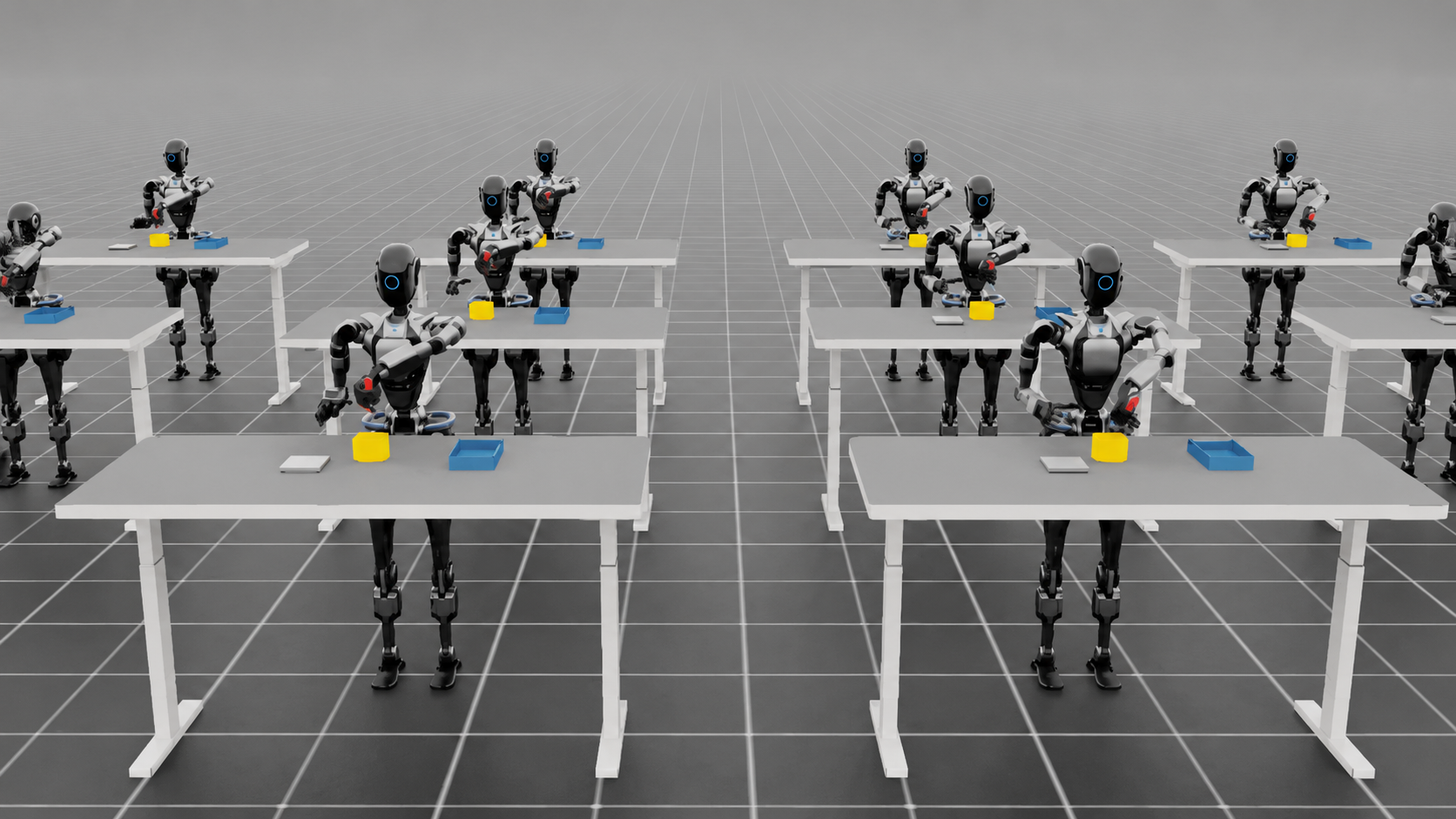
Sim-to-Real pipelines offer a way around this limitation. Using platforms such as NVIDIA’s Isaac Lab, developers can train robotic systems inside simulated environments before deploying them in factories, warehouses, or other physical settings.
Within these virtual worlds, robots can perform millions of repetitions across continuously changing conditions. Developers can vary lighting, object placement, surface friction, equipment configurations, and unexpected obstacles without rebuilding a physical test environment for every scenario.
Simulation also lowers the cost of failure. A virtual robot can fall, collide with equipment, or choose the wrong action without injuring anyone or damaging expensive machinery. The behaviors and control strategies learned in simulation can then be transferred to physical robots and refined using real-world data.
This allows robotic learning to occur closer to the speed of computation than the speed of physical movement. As simulation becomes more realistic and models become better at transferring virtual experience into real environments, the development cycle for new robotic capabilities should become faster and less expensive.
Productivity and Cost as Economic Drivers
The robotics sector is expanding as intelligent machines become capable of performing a wider range of physical tasks at a lower cost. In manufacturing, logistics, construction, agriculture, maintenance, and healthcare support, robotic systems can increase output, improve consistency, reduce material waste, and perform work that is dangerous or physically demanding.
Aging populations and worker shortages are accelerating adoption, particularly in countries where the working-age population is shrinking. Businesses facing persistent labor constraints are increasingly treating automation as necessary infrastructure rather than an optional upgrade.
The larger economic incentive, however, is productivity. Physical AI allows companies to increase output without requiring a proportional expansion of their workforce. Tasks that once depended entirely on scarce human labor can be performed more continuously, predictably, and eventually at a lower cost.
The business model of robotics is also changing. Robot-as-a-Service allows companies to access robotic fleets through subscriptions or usage-based pricing rather than purchasing expensive systems upfront. This can make automation more practical for smaller businesses while shifting maintenance, upgrades, and technical support to specialized providers.
Open-source software and shared development tools are widening participation further. Libraries such as Hugging Face’s LeRobot allow AI researchers, software engineers, roboticists, and hardware designers to build on common frameworks instead of developing every component independently.
As hardware production scales, software improves, and competition expands, the cost of robotic labor should continue to decline. The benefits should extend well beyond corporate profits. Lower production, construction, transportation, and service costs should eventually translate into more affordable goods and services throughout the economy. Industries may gain the ability to build more housing, grow more food, maintain more infrastructure, deliver more healthcare support, and manufacture more goods without a comparable increase in labor or production costs.
As Physical AI moves from laboratories into everyday infrastructure, its most consequential effect may not be the visibility of robots themselves. It may be the gradual reduction in the cost of nearly everything people need.
Leave a Reply