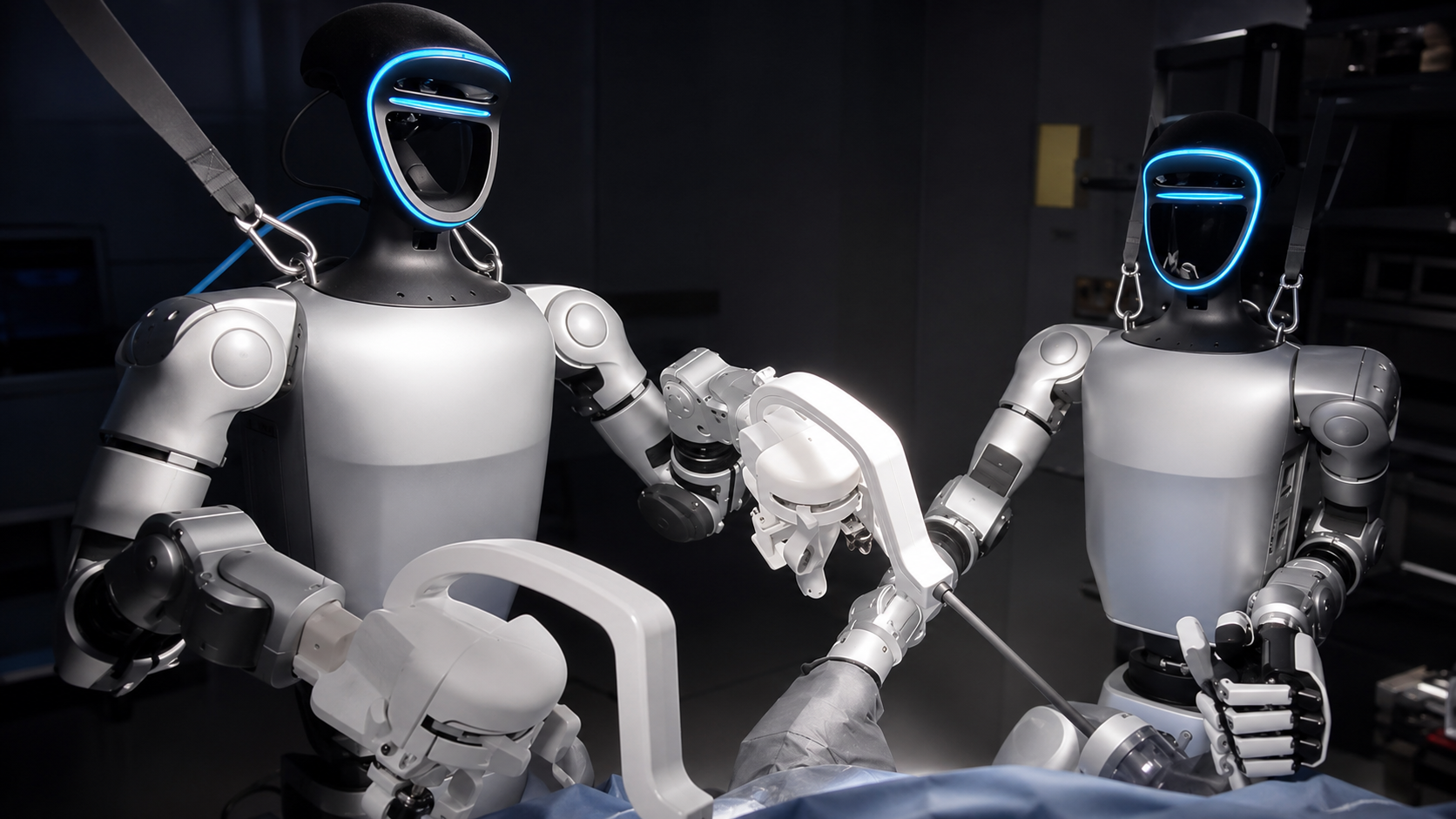
A new generation of adaptable medical robots is reshaping how surgical expertise is delivered.
July 9, 2026
UC San Diego researchers use teleoperated humanoid robots to perform gallbladder surgery, pointing toward more flexible and remotely accessible surgical care.
Led by Professor Michael Yip of the UC San Diego Jacobs School of Engineering, the research team conducted two preclinical gallbladder-removal procedures on live pigs. During one operation, a humanoid robot worked alongside a human surgeon; during the other, two humanoid robots operated as a robot-robot team.
The robots stood approximately five feet tall and weighed just 60 pounds. Rather than relying on the massive, stationary platforms that currently dominate robotic surgery, they operated inside a conventional surgical environment using standard medical instruments.
This smaller, more adaptable design could prove important. Existing robotic surgery systems can weigh more than 1,800 pounds and often require operating rooms designed specifically around their hardware. Humanoid robots, by contrast, are intended to function within spaces, workflows, and tool systems originally created for people.
Extending the Surgeon’s Hands
The procedures were not autonomous. Surgeons controlled the robots in real time using motion-capture equipment, tracking systems, and foot pedals.
The machines effectively acted as physical extensions of the surgeons operating them. Movements performed by the human operator were translated into corresponding robotic actions, allowing the humanoids to manipulate tissue, hold instruments, retract organs, dissect material, and place surgical clips.
Teleoperated surgery itself is not new. What distinguishes this experiment is the use of general-purpose humanoid hardware rather than a machine engineered exclusively for one surgical configuration.
Most medical robots are built around narrow and highly controlled tasks. Humanoid systems are designed for a broader challenge: interacting with environments built for human bodies. Their arms, hands, reach, and range of motion allow them to use existing instruments and move through existing workspaces without requiring the entire environment to be redesigned.
The trial suggests that humanoid robots may be capable of performing tasks that demand both physical adaptability and extreme precision. Surgery represents one of the most difficult possible tests because mistakes can damage delicate tissue and immediately endanger a patient.
From Specialized Machines to Versatile Robots
Robotic surgery has historically followed the logic of industrial automation. Engineers design a highly specialized system around a clearly defined task, environment, and set of movements.
This approach can produce exceptional precision, but it also creates large, expensive machines with limited flexibility. A system designed for one operating-room setup may not be easily moved, repurposed, or used in a smaller medical facility.
Humanoid robots represent a different model. Instead of redesigning the workplace around the machine, engineers attempt to build machines that can enter human environments and use the same tools people already use.
In medicine, that could mean a single robotic platform performing many supporting roles. The same machine might prepare instruments, move equipment, assist a surgeon, monitor supplies, clean parts of the operating room, and eventually participate directly in procedures.
This versatility could reduce the need for separate robotic systems for every medical task. It could also make surgical robotics more practical for hospitals that cannot afford to build dedicated facilities around specialized equipment.
Surgery Across Distance
The most far-reaching implication is the possibility of separating surgical expertise from physical location.
Advanced surgery is concentrated in major hospitals and urban medical centers, where specialized physicians, equipment, and support teams are available. Patients in rural regions, isolated communities, disaster zones, or conflict areas may need to travel long distances or may not have access to advanced procedures at all.
A portable teleoperated humanoid could allow a specialist in one location to operate a machine somewhere else. Rather than transporting the patient to the surgeon, the surgeon’s movements could be transmitted to the patient’s location through the robot.
In principle, this could enable highly trained surgeons to perform or assist with procedures from hundreds or thousands of miles away. A remote clinic might not need a full staff of specialists if a local medical team could work alongside robotic systems controlled by experts elsewhere.
The technology could therefore turn medical skill into a more distributable resource. Expertise would remain with the surgeon, but its physical reach would no longer be limited to the room in which the surgeon was standing.
This would not eliminate the need for local clinicians. Surgical patients still require preparation, anesthesia, monitoring, emergency support, and post-operative care. But teleoperated robots could expand what smaller medical teams are capable of doing when specialist knowledge is unavailable locally.
The Limits of Remote Surgery
Moving from controlled laboratory trials to routine clinical use will require major advances in reliability, communication, and safety. During the early demonstrations, the humanoid robots required periodic recalibration. These interruptions extended the duration of the procedures compared with current surgical systems.
In a laboratory, delays can be tolerated. In a real operating room, every interruption increases risk. A clinical robot would need to maintain precise positioning and control over long periods without drifting, losing calibration, or responding unpredictably.
Communication latency presents another challenge. Teleoperation depends on transmitting the surgeon’s movements to the robot and returning visual and sensory information to the operator. Even small delays can make precise movements more difficult.
For local teleoperation, latency may be minimal. Long-distance surgery is more demanding because signals must travel through communication networks that can experience congestion, interruptions, or variable performance.
A safe system would need redundant connections, emergency controls, and procedures for continuing or stopping an operation if communication were lost. Hospitals would also need trained personnel capable of responding immediately if the robot malfunctioned.
Cybersecurity would become another layer of medical safety. A teleoperated surgical platform connected to external networks would need protection against unauthorized access, interference, and data theft.
In this context, network reliability and software security would become as important as mechanical precision.
Assistants Before Surgeons
The most likely path into hospitals may begin with lower-risk responsibilities.
Humanoid robots could initially serve as surgical assistants, carrying equipment, organizing instruments, positioning cameras, preparing operating rooms, or completing cleanup tasks. These roles would allow hospitals to test the systems without immediately placing them in full control of delicate procedures.
As reliability improves, the robots could take on more complex responsibilities under direct human supervision. They might hold tissue steady, operate suction tools, pass instruments, or perform repetitive actions while a surgeon handles the most difficult parts of the procedure.
Over time, some tasks could become partially autonomous. A robot might stabilize its own movements, avoid sensitive structures, or automatically compensate for tremors and delays while still following the surgeon’s broader commands.
Full surgical autonomy would be a much larger step. It would require not only physical dexterity, but also the ability to interpret unexpected conditions, recognize complications, and choose appropriate responses in real time.
The UC San Diego experiments do not demonstrate that level of intelligence. Their importance lies in showing that a humanoid platform can already serve as a controllable physical interface between a surgeon and a living body.


Leave a Reply