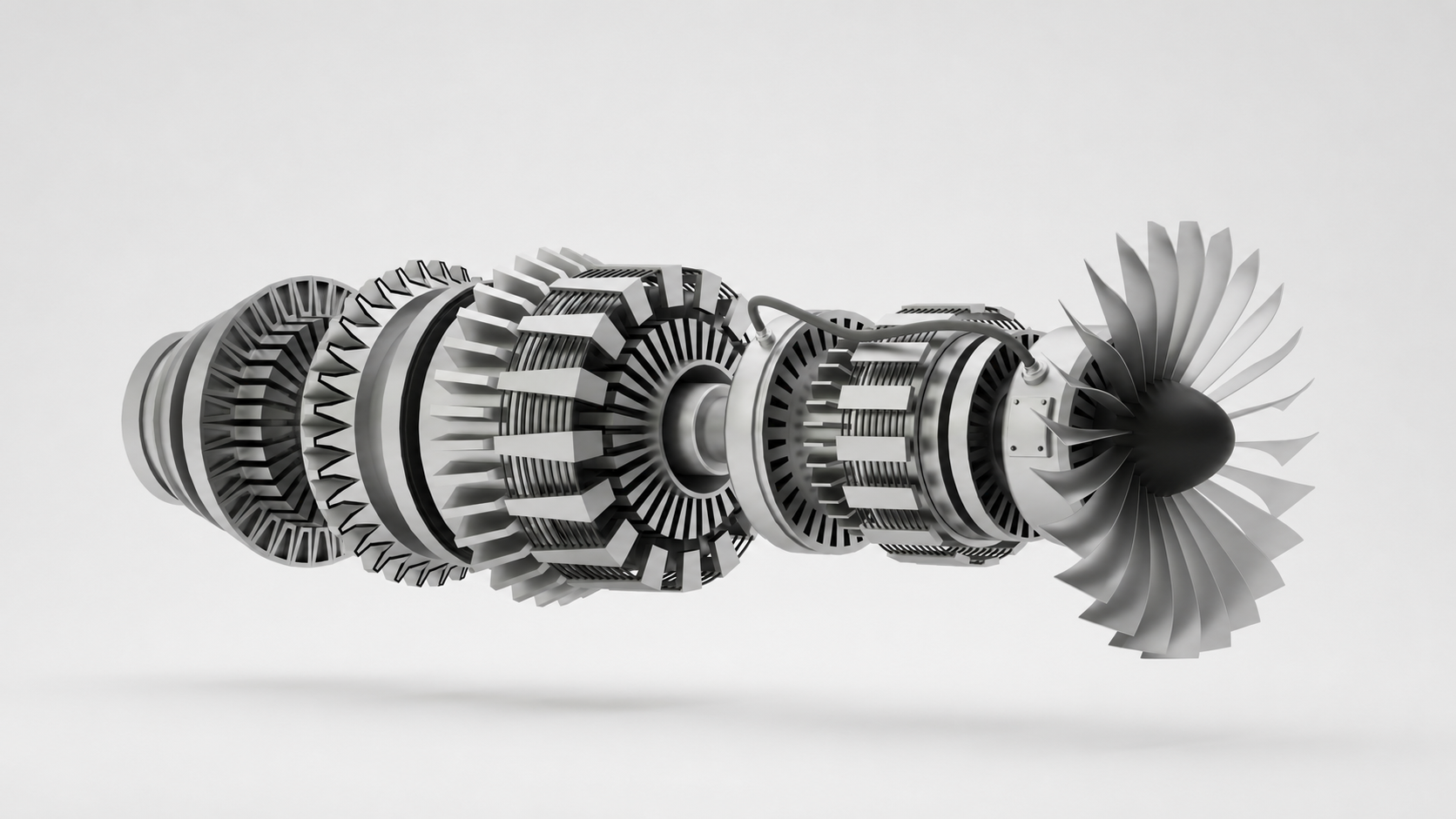
Why AI’s power buildout is running into a shortage of gas turbines.
July 11, 2026
The AI revolution is moving beyond digital systems and into the physical constraints of industrial infrastructure. As electricity demand from data centers accelerates, developers are increasingly turning to new gas-fired generation. But the large turbines required to build those power plants are produced by only a handful of manufacturers, and much of their available capacity is already committed years in advance.
The Industrial Bottleneck
Electricity supply and grid equipment were once secondary considerations in many data center projects. That is changing as rapidly rising power demand collides with limited manufacturing capacity for gas turbines, transformers, and other utility-scale equipment. Procurement has become a major source of delay and cost, forcing data center developers, utilities, and industrial firms to compete for a relatively small pool of available machinery.
The constraint is especially severe for large gas turbines, a market dominated by GE Vernova, Siemens Energy, and Mitsubishi Power. These machines are complex, expensive, and produced in limited numbers, making it difficult for manufacturers to respond quickly to sudden demand. Wood Mackenzie projects that turbine prices could reach $600 per kilowatt by the end of 2027—195% above 2019 levels. GE Vernova alone has reported roughly 100 gigawatts of backlog and reserved production slots, while other manufacturers have sold much of their available capacity through the end of the decade.
The shortage extends beyond turbines: high-voltage transformers, essential for moving electricity onto the grid, can now carry lead times of several years. What was once a routine equipment order has become a strategic contest for access to the machinery required to build new power.
The Death of Just-in-Time Infrastructure
The severity of these shortages has forced developers to abandon the “just-in-time” procurement strategies that defined the last several decades of infrastructure investment. Previously, firms waited until a project secured all necessary permits and environmental approvals before ordering equipment.
Today, that approach is a recipe for failure. Developers are now pivoting to a “buy now, permit later” strategy, paying significant premiums to reserve manufacturing slots years before breaking ground. This climate of scarcity has inevitably birthed a “double-ordering” phenomenon, where companies book capacity with multiple suppliers to hedge their bets, inadvertently masking the true, crushing depth of the equipment shortage.
The Rise of Parallel Energy Systems
This hardware scramble is driven primarily by hyperscalers—the massive cloud providers who find the public electrical grid’s administrative timelines incompatible with their rapid, 12-to-24-month data center construction cycles. To maintain their pace, these firms are increasingly opting for “behind-the-meter” power solutions. By building their own dedicated power plants, they are essentially constructing a parallel energy system that bypasses the constraints of the regional power grid.
While this allows AI infrastructure to scale at the speed of software, it concentrates the demand for industrial hardware within a single, dominant sector. Consequently, data center operators are now outbidding traditional utilities and industrial firms for limited factory capacity, creating a ripple effect that is beginning to exert upward pressure on retail electricity costs for the public.
Intelligence as a Physical Constraint
We are entering a phase where artificial intelligence is tethered to the physical world more tightly than ever before. Scaling intelligence is no longer exclusively about optimizing neural network architectures; it is about securing the heavy machinery required to power the processors themselves.
This shift highlights a profound civilizational transition: as we attempt to accelerate the evolution of machine intelligence, we are hitting the hard limits of our industrial capacity. The companies that emerge as the leaders of the next decade will not necessarily be those with the most sophisticated algorithms, but those with the deepest, most resilient supply chains. This “turbine scramble” serves as a reminder that the digital future rests entirely on a foundation of tangible, physical hardware—and that foundation is currently being pushed to its absolute limit.
Leave a Reply